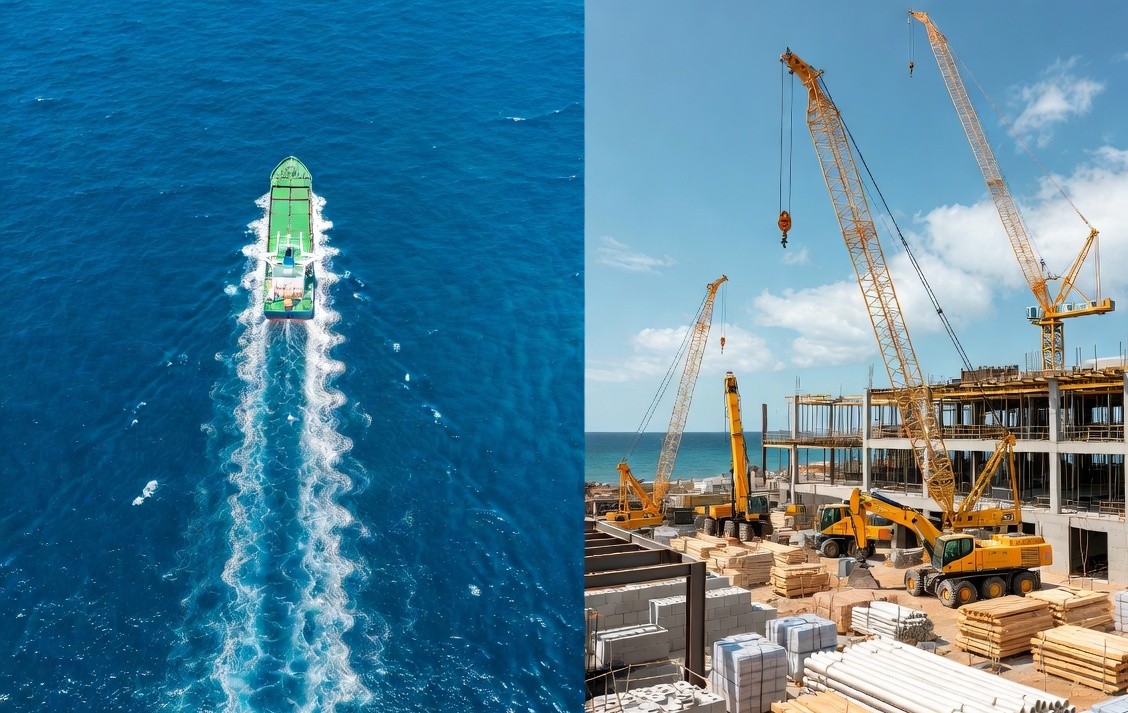
Remember when the biggest thing contractors worried about was getting materials on site? Those days feel like ancient history right now. It’s now that the Middle East war is increasing construction costs.
On February 28, 2026, coordinated US and Israeli airstrikes on Iran closed off one of the world’s most critical shipping corridors: the Strait of Hormuz. Western commercial vessels can no longer use it. That 20% of the global oil and gas supply that normally flows through there? Now it’s taking a massive detour around the Cape of Good Hope, adding thousands of kilometres to every journey.
The ripple effects have been swift and brutal. According to analysis from Rawlinsons Cost Data, we’re seeing a construction cost crisis that’s going to touch almost every project in Australia.
This is a story about more than just cost overruns, though. It’s about asset protection, risk management, and why the property market fragmentation we’ve been discussing isn’t just a valuation problem. It’s becoming a financial exposure problem.
What’s Actually Happening Out There
This isn’t just fuel prices creeping up a bit. We’re talking about three major channels of impact hitting construction simultaneously:
1. Fuel Costs for Equipment Your diesel-powered site vehicles, concrete pumps, excavators (everything that keeps a site moving) just got more expensive to run. And yes, contractors are passing these costs through.
2. Material Price Explosions This is where things get real. Rawlinsons Cost Data is tracking some genuinely concerning price movements:
- Plastic pipe products (PVC, PE, PP): up 30–40%
- Bitumen and asphalt: up 30–50%
- Concrete: up $8/m³
- Steel reinforcing and structural: up 5–10%
- Aluminum cladding: up 10%
- Glazing: up 9–10%
- Laminated timber products: up 5–6%
- Quarry products: up around 5%
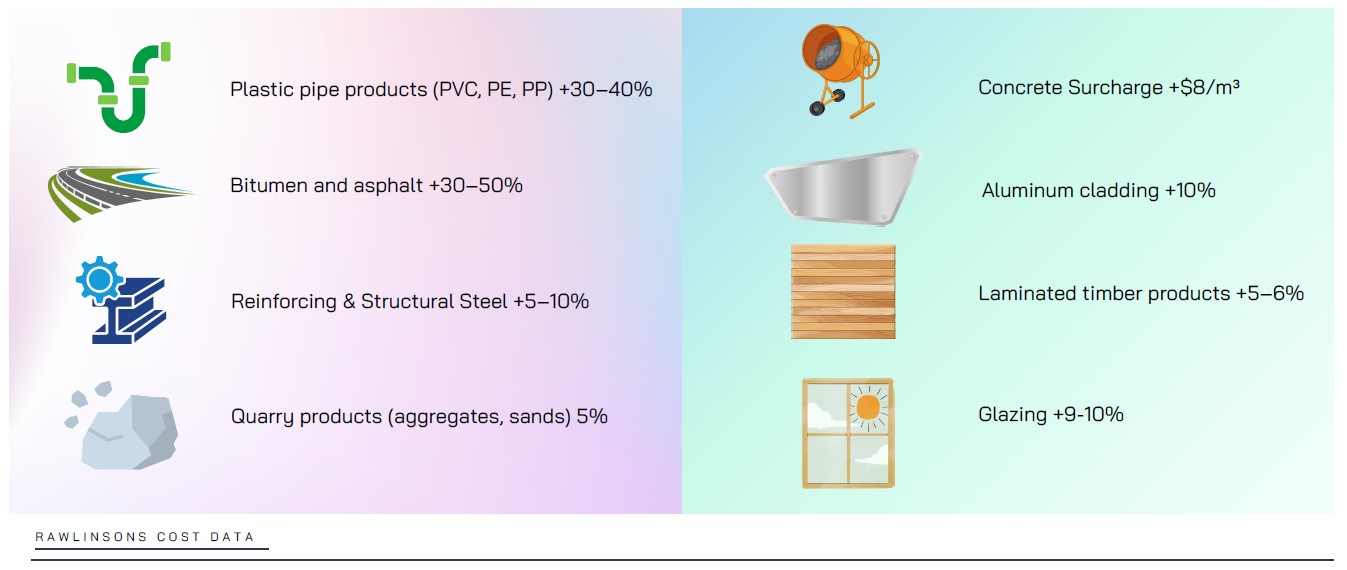
These aren’t marginal increases. These are the kinds of price movements that ripple through budgets.
3. Logistics Costs Container shipping rates jumped approximately 15% in March 2026 alone. For domestic freight, fuel surcharges are running 10–25% depending on the operator. If your project depends on imported equipment or specialist components (and most do), you’re paying more to get it here.
The Supply Chain Nightmare
It’s not just cost, either. Lead times are getting longer and less predictable, and that’s creating real schedule risk.
Rawlinsons Cost Data identifies three high-risk material categories right now:
- Facade and glazing systems
- Mechanical and electrical equipment
- Fixtures and specialist imported components
The uncomfortable truth? The suppliers you’ve relied on for years can’t be taken for granted anymore. Supply chain reliability isn’t what it was.
Here’s the Part Nobody’s Talking About: Insurance Implications
If you own property and you’re planning renovations or new construction, here’s something to add to your worry list: rising construction costs mean your insurance coverage might not be adequate anymore.
We’ve written about this before. Your home insurance valuation needs to reflect actual replacement costs, not what you paid for the property five years ago. But when materials are up 30–50% and freight costs are spiking 15%+, those replacement costs have just moved significantly.
Read: Home Insurance – Are You Adequately Insured?
If you haven’t had your insurance valuation reviewed recently, now is genuinely the time. The gap between what you think your home would cost to rebuild and what it actually costs is getting larger, not smaller. You could be underinsured without realising it.
And if you’re managing a Self-Managed Super Fund with property assets, the same principle applies. Asset valuations for SMSF reporting need to reflect current market conditions and replacement value realities.
Read: The Importance of a Professional Valuation for SMSF Financial Reporting
How Markets Are Responding
Contractors are adapting, but the changes tell you something about how serious they think this is:
- Tender validity periods are shortening (because price certainty is disappearing)
- Fewer contractors will lock in fully fixed-price contracts
- Material escalation clauses are now standard
- Early procurement of critical items has become non-negotiable
- Risk allocation is shifting hard toward project principals
This isn’t contractors being awkward. It’s contractors protecting themselves against real uncertainty.
The Contract Problem
Here’s the awkward part: many standard Australian construction contracts weren’t designed for this kind of disruption.
Force majeure clauses are often narrowly drafted. Supply chain disruption might not even be covered. Relief clauses frequently limit you to time adjustments, without actually recovering the cost impact. Contractors are pricing additional contingency into tenders based on what they learned during COVID, which means your baseline costs are already higher.
What Might Actually Happen
Rawlinsons Cost Data has modelled two scenarios for metropolitan commercial building projects:
Scenario 1: Short-Lived Disruption
- Fuel prices normalise by mid-2026
- It’s just a short-term spike
- Impacts project costs by approximately +1–2% above baseline escalation
Scenario 2: Prolonged Crisis
- Elevated fuel prices persist through late 2026 and beyond
- Sustained pressure on materials, logistics, and site preliminaries
- Particularly hits long-duration projects
- Impacts projects by approximately +6–9% above baseline escalation
Civil and infrastructure projects? They’re going to cop even bigger impacts than commercial buildings. Regional projects are tracking worse than metropolitan ones.
And here’s the part that ties back to the bigger property market story: this regional vs metropolitan divide is a microcosm of a much larger fragmentation we’ve been tracking. Different property markets are experiencing entirely different realities right now (different growth patterns, different risk profiles, different renovation and development economics).
Read: Why There Is No Such Thing as “The” Australian Property Market in 2026
If you own property in regional Australia or you’re considering development there, the construction cost implications are more severe. That changes your investment calculus. It changes what assets are actually worth. It changes what insurance coverage you need.
Which scenario plays out depends on factors nobody can really predict with confidence right now.
What You Actually Need to Do About This
If you’re involved in construction (whether you’re the client signing off on budgets, the contractor putting in tenders, or the consultant running the numbers), here’s what Rawlinsons Cost Data is recommending:
- Review your contracts now. Don’t assume your risk allocation clauses handle this. They probably don’t.
- Plan procurement early and rigorously. For high-risk material packages, get ahead of the market. Wait six months, and you might be chasing stock.
- Share risk transparently. The days of hiding contingency are over. Clients, contractors, and consultants need to understand what’s actually at stake.
- Watch the markets. Fuel prices, freight costs, and supplier capacity are moving targets. Set up proper monitoring rather than hoping things stabilise.
- Communicate constantly. When things are uncertain, silence creates rumours and bad decisions. Transparent, regular communication actually prevents blowouts.
But here’s the bit that applies to everyone with property assets:
- Get your insurance valuation reviewed. Seriously. If you haven’t done this in the last 12 months, the gap between your cover and your actual replacement cost is widening. Construction cost inflation is real, and it’s accelerating.
- Understand your property’s actual market position. Is it in a metro area where impacts are moderate, or regional where they’re severe? What’s the realistic replacement cost if something happens? That shapes both your insurance needs and your investment strategy.
We’ve written about protecting your assets before, whether that’s through proper valuation for insurance purposes or understanding your property’s true value in today’s fragmented market. Those conversations just became more urgent.
Read: A Practical Guide to Asset Protection to understand what asset protection really means in the current environment.
The Bottom Line
No single strategy eliminates volatility right now. But a structured, collaborative approach (where project teams acknowledge the real risks and share responsibility for managing them) can materially improve outcomes.
The perfect storm is real. But how much damage it does to your project depends on how well you prepare for it now.
And if you own property, it’s also a reminder that knowing what your assets are actually worth and making sure they’re properly protected isn’t a nice-to-have. It’s essential.
Data sourced from Rawlinsons Cost Data, April 2026. For more market insights and detailed analysis, visit Rawlinsons Insights