Before you object, know what the Valuer General will see.
We review every issued land tax value in your NSW portfolio.
We tell you which ones are worth challenging, and which to leave well alone because objecting could cost you more.
Only 44 spaces left. Applications open once a year.
Objecting can put your land value up.
You ask for a reduction. The Valuer General can raise it instead. The legislation allows it.
Your valuer may not know the rules.
Statutory land valuation has its own legislation and process. I reviewed many objections from valuers who didn’t know either. They were doing their clients a disservice.
The market rose 10%. The land value rose 30%.
I’ve seen values lifted well past what the market did once an objection showed they were set too low. There is no limit on how much the Valuer General can lift a value from one year to the next.
Past values can be changed too.
Under section 14A(6) of the Valuation of Land Act 1916, the Valuer General can go back and change values already issued, not just this year’s.
Objections are how undervalued land gets found.
The valuers setting values for the Valuer General each hold thousands and can’t check every one. Objection reports showed us which ones were set too low.
If a value is low, an objection is how the Valuer General finds out.
Mass valuation gets some properties wrong in both directions. If a value has been set too high you are paying more land tax than you should. If it has been set too low you are paying less, and there is no reason to draw attention to it.
The problem is that you cannot tell which is which by looking at the value. The legislation can also change what that correct value is. Our advice protects you.
A valuer acting for the Valuer General reviews the land value properly, for the first time. Not by mass valuation, but by looking at that property and the sales evidence around it.
They are not limited to the reduction you asked for. If the evidence shows the value was set too low, they can raise it. This is in section 14A(6) of the Valuation of Land Act 1916.
A higher value flows into the averaging used for later years, so one objection on the wrong property can raise the land tax you pay on it for years afterwards.
This is the part of the job we are actually being paid for.
Finding a property where the value looks high is not difficult. Working out which of your properties are already sitting below what the evidence supports, and leaving those alone, is the work that protects you.
Every property we recommend leaving alone is a property that does not go in front of the Valuer General at all.
We do not recommend objecting simply because a land value appears high.
On a portfolio of any size, the cost of getting this wrong on two or three properties can wipe out the benefit of getting it right on the rest.
Sometimes the correct recommendation is to do nothing.
A reduction you may already be entitled to, and may not be getting.
Some land attracts a concession that reduces the value land tax is assessed on. Heritage restrictions, certain planning limits and particular uses can all qualify, depending on the property.
These are not always applied, and where they are, they are not always applied correctly. A concession that should be in place and is not will quietly cost you every year it is missed.
We check each property for a concession that should be applied, and check that the ones already in place are right.
One clear recommendation for every property
We review every property in the portfolio and tell you where we believe action is warranted, where further investigation is required, and where we recommend no action.
The current value sits materially above our indicative range, and the difference can be traced to specific features of the site or clearly better evidence. We recommend a detailed objection valuation.
The answer depends on information not yet available, such as heritage listings, hazard mapping or survey detail. We tell you exactly what is needed before a decision is made.
The current value is reasonable on the evidence, or an objection would risk an increase. We say so plainly, so time and fees are spent only where they are likely to matter.
Twelve properties. Three objections. Seven left alone.
Our illustrative example follows a fictional private client with twelve Sydney properties. It shows the kind of report a client receives and how the recommendations are reached.
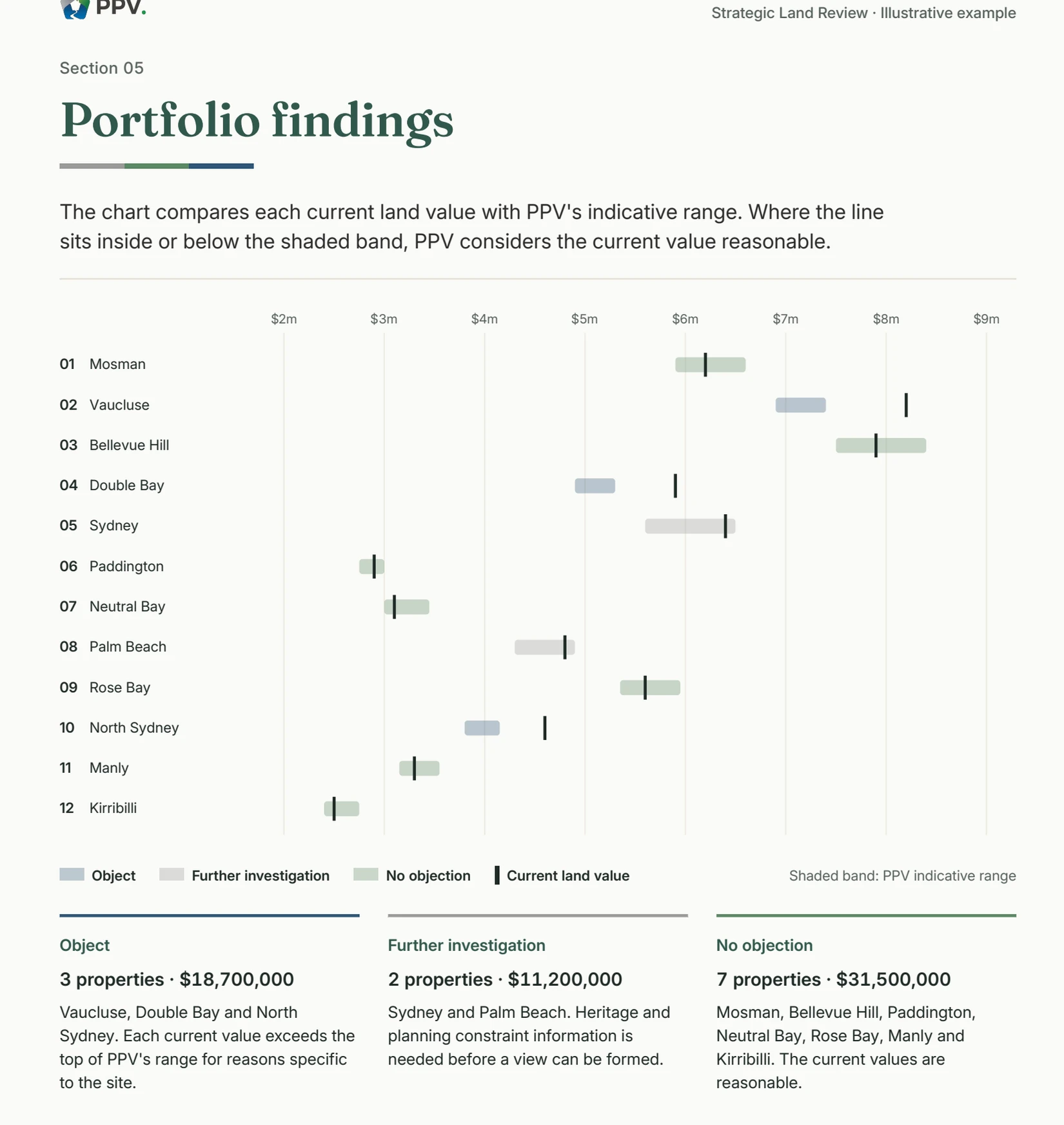
The whole portfolio on one page
Each current land value is set against our indicative range for that property. Where the value sits inside or below the band, we consider it reasonable. Where it sits clearly above, we look for the reason.
In the sample, the three values recommended for objection each carry a site specific explanation: a steep battle-axe block, a narrow mid-block commercial site, and a fringe site under lower height controls.
Why some properties should not be challenged
A high property value does not mean the land value is too high. The statutory land value excludes the house, pool and landscaping. The better test is whether it matches sales of comparable land.
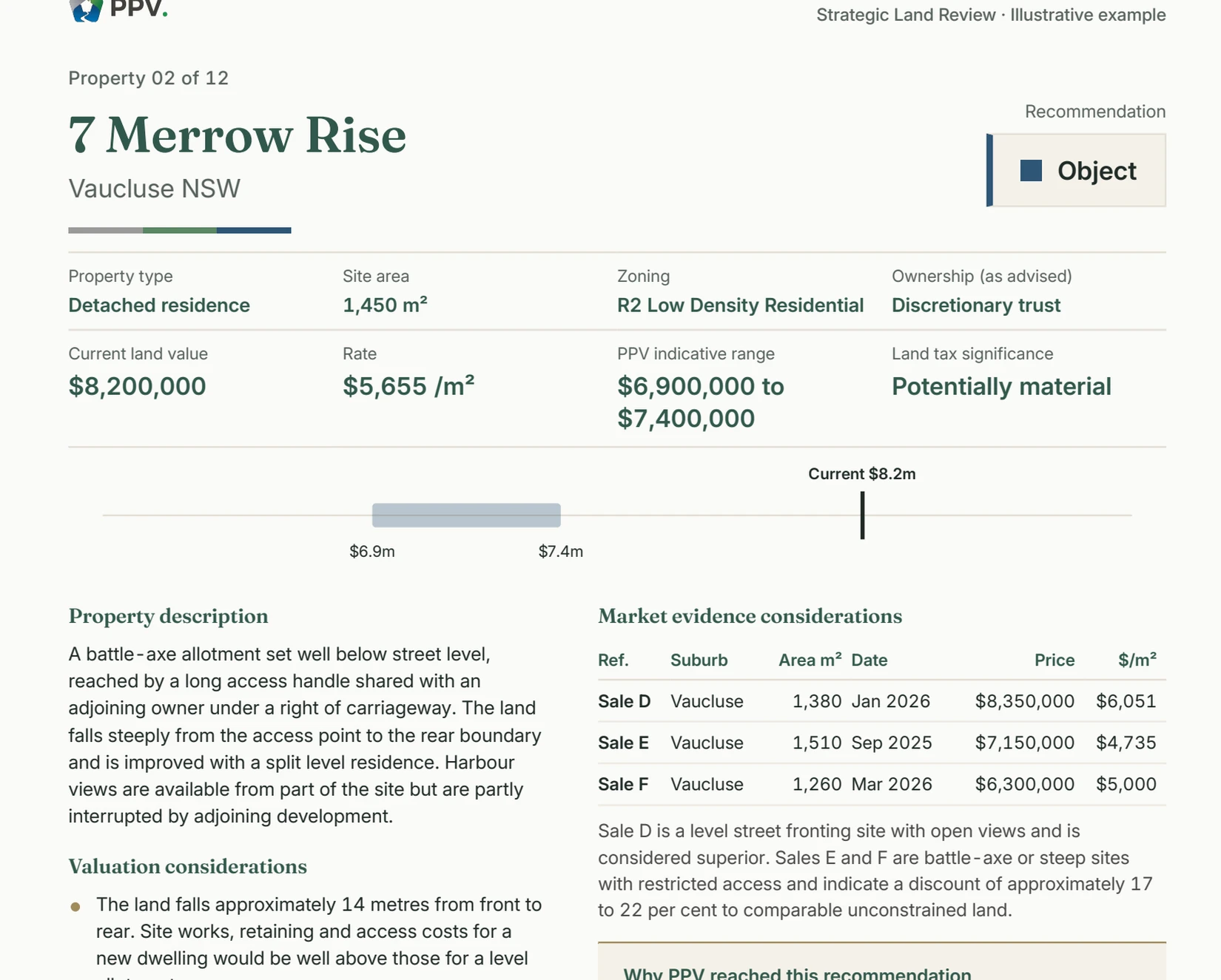
Current value of $8.2m against a range of $6.9m to $7.4m. A steep fall, a shared access handle and a rear easement reduce the usable building platform.
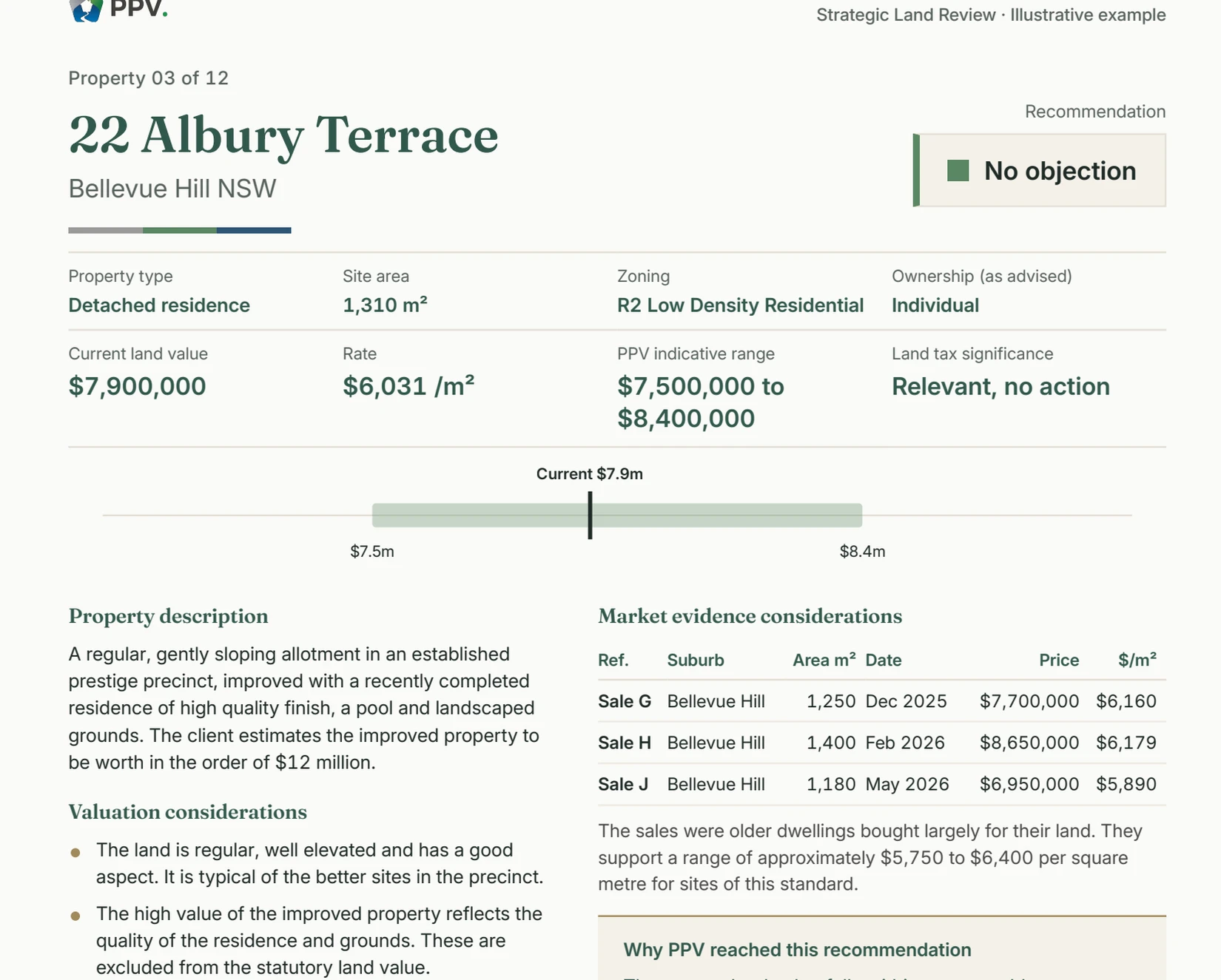
A property worth around $12m with a land value of $7.9m. The value sits within the evidence, and the top of the range is above it. Objecting would be more likely to confirm or raise it.
Properties, values and sales in the sample report are fictional.
I have read the objections that should never have been lodged.
For years I prepared objection reports on behalf of the Valuer General of NSW. I saw a great many objections that should never have been lodged, by valuers for their clients and by owners for themselves. Neither knew the legislation, or what happened to an objection once it was in.
Before that, I set and issued land values for the Valuer General. Every year we reviewed the objection reports. When one showed a value was too low, that was evidence to lift it. The market might have risen 10% that year. That value could go up 30% or more. There is no limit on how far it can be lifted.
The legislation also lets the Valuer General reascertain values already issued. No valuer can check every one of the many thousands they hold, so objections were one of the ways undervalued land was found.
Now I am here to protect you.
Sam Percy, AAPI Certified Practising Valuer
I know how the Valuer General assesses an objection. I used to do it.
PPV's principal, Sam Percy, has spent more than a decade working with NSW statutory land values, including work as a contractor to the Valuer General of NSW and the review of land value objections lodged by other valuers.
- —Work undertaken as a contractor to the Valuer General of NSW
- —Involvement in the issuance of statutory land values
- —Completing and reviewing land value objection work
- —Assessing objection evidence
- —Understanding the Valuer General valuation and objection process
He has prepared the objections, and he has assessed them.
Most valuers have argued for a land value to be reduced. Far fewer have sat on the other side and decided whether that argument succeeds. Sam has done both, so he knows which arguments hold up, and, more usefully, which properties a reviewing valuer will look at and quietly conclude were undervalued all along.
That is how we know which properties to leave alone.
Statutory land valuation is not ordinary valuation work.
Statutory land values are determined within a specific legislative and valuation framework, with its own evidence, assumptions, methodology and objection process.
Valuing a house for a bank and defending a statutory land value are different tasks with different evidence and different rules. A valuer can be very good at the first and have never done the second.
From portfolio list to clear priorities
Send us the addresses and current land values, with ownership and use for each property.
Planning controls, site characteristics, encumbrances and comparable sales, property by property.
A recommendation for each property, an indicative range, the evidence, and a priority order.
Where an objection is warranted, we can prepare the detailed objection valuation as a separate engagement.
A report written for your portfolio, not a checklist
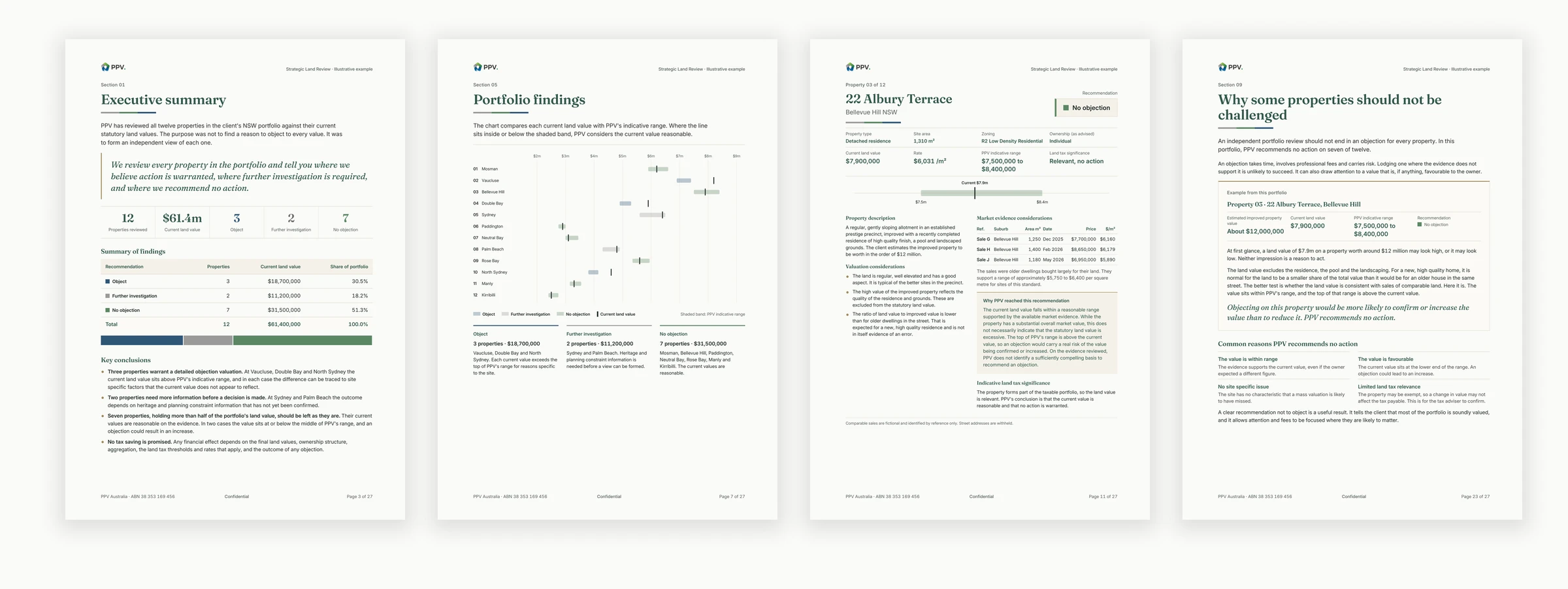
We do not promise a tax saving or estimate one. The effect of any change depends on the final value, your ownership structure, aggregation, the thresholds and rates that apply, and the outcome of any objection. We are happy to work alongside your accountant or tax adviser.
A deliberately limited service.
Every property is assessed individually, and we stay involved through the objection period rather than handing over a report and leaving.
For that reason, PPV accepts only 44 portfolios a year. Applications open and close once a year. Once the places are filled, further enquiries are held for the following review year.
Before you ask
Will you recommend objecting on every property?+
No. In most portfolios we expect many values to be reasonable. Telling you which ones to leave alone is part of the service.
Can an objection increase my land value?+
Yes. Yes. Objecting asks the Valuer General to look at that property properly. If the evidence shows the value was set too low, they can raise it rather than lower it, and the higher value carries into later years. That is why we tell you which properties to leave alone.
Why might you recommend not objecting?+
Usually because the value is already at or below what the sales evidence supports. Objecting on that property invites a review that is more likely to raise the value than lower it.
Is the review a formal valuation?+
No. It is a desktop review with a preliminary range for each property. Where an objection is recommended, a detailed objection valuation with inspection is a separate step.
How is the review priced?+
Fees are set according to the scale and complexity of the portfolio and the level of professional work involved. They are provided privately following an initial discussion.
Is there a deadline to object?+
Yes. An objection must be lodged within the period stated on the relevant notice. Contact us early so the strongest cases can be prepared in time.
If a matter goes further
The annual fee covers the review itself and any objections we recommend and prepare. Most matters are resolved at that stage.
Occasionally a matter proceeds to the NSW Land and Environment Court. That is not part of the annual service and only arises if you decide to pursue it. Court work is quoted separately before any commitment is made.
Join the 2027 waitlist.
Tell us a little about your portfolio so we can determine whether the Strategic Land Review is appropriate for you. Approximate figures are fine. There is no obligation.
- We contact you to arrange a private discussion.
- We confirm the scope for your portfolio.
- We provide the annual fee privately, in writing.
Thank you.
Your request for a portfolio review has been received. We will contact you to arrange a private discussion.
Nothing further is needed from you at this stage.